
Groundlessness
Part 2: Stepping through the porthole

From Part 1:
Jesus turns “neighbor” into a verb of personal action: “being neighbor to.”
The promise here is that every one of us is born capable of making that change from noun to verb…. We can sit with our own discomfort, just let it be there. At the same time we can open ourselves to those others….
Removing artificial backgrounds and frames doesn’t fix the situation. It enables us to enter into the situation along with the other person.
I often don’t do this well, especially with people I find difficult. When I “have to” deal with them, I use all sorts of frames and backgrounds to keep them at a distance. Lots of categories of people I just avoid altogether. In particular I avoid people I perceive as reactionary, those who like to argue and who refuse to engage in collaborative disagreement over a common concern.
But also, ironically, I avoid many people in the “marginalized demographics”—at least if they haven’t learned to assimilate into White middle-class American culture. Racism and classism seem to be part of my DNA, even though I was raised to strive to be otherwise. Such avoidance is a mix of guilty White paternalism and gut-level fear of being the ignorant, privileged White boy among people with way more street sense and a stronger community of mutual care.
In 1965, my family moved from Boston to Columbia, SC. Recreating my Boston school experience, I began making Black as well as White high school friends—until one day in the lunch room two White friends told me I couldn’t sit with them anymore. I rolled with this, but a few years later in the parking lot a White boy called out “nigger-lover.” My Black companion wanted to fight, but I held him back. “I don’t mind,” I said. It was decades before I realized to my shame that the insult had been aimed at him, one he probably heard daily.
Can you see how subtly our frames and background distort perception and judgment? Is there a way forward, a way through?
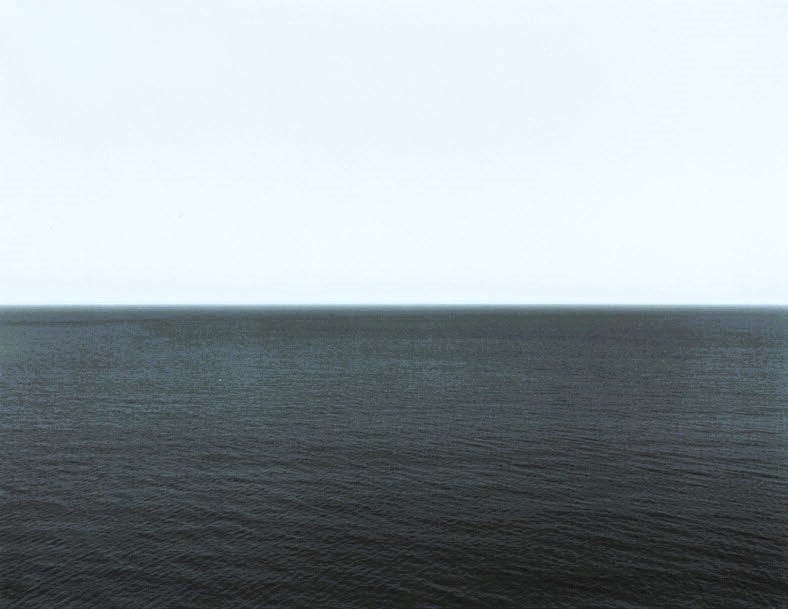
The antique bronze frame in Hiroshi Sugimoto’s “Time’s Arrow” collage surrounds a segment of this earlier photo, “Caribbean Sea, Jamaica.” The challenge we all face is this: to leave behind the background and the frame. To step through the porthole into the groundlessness of the real world, where there is only the sea and the sky, with no certain place to stand.
This can be extremely disorienting and frightening. To face the real world, to face the every-changing, contradictory flood of events and information and emotions—without defenses. To turn around and look at ourselves as we learn to act in the real world.
No practical path to maturity pretends that we can do this for more than moments at a time. The biologically normal way for mortal beings is to stay safely within known frames as much as possible. There is nothing wrong with this as a survival strategy.
Even so, we may rush along without awareness of how our frames both direct and mislead us. Then we become like charging rhinos or like antelopes scattering out of the rhino’s way. We are not free agents in the real world. Merely creatures led by reflexes.
How do we learn? How do we find a way to act in good conscience in the midst of groundlessness? Eleanor Roosevelt named the opening move when she said, “Do one thing every day that scares you.” But then what? What infinitesimal steps can we take over and over again to stay with the uncertainty, the unknowability for a few seconds or minutes?
I ask, because that is our only way toward maturity. More, our only way toward healthy collective engagement. To demonstrate to ourselves that we can, in fact, spend time with the discomforts of being without our normal frameworks for coping. More than anything, such a path calls for great compassion and kindness towards ourselves. Because we are allowing the real world to teach us.
One caveat from Buddhist teacher Pema Chödrön:
When we are training in the art of peace, we are not given any promises that because of our noble intentions everything will be okay. In fact, there are no promises of fruition at all. Instead, we are encouraged to simply look deeply at joy and sorrow, at laughing and crying, at hoping and fearing, at all that lives and dies. We learn that what truly heals is gratitude and tenderness.
The next post delves deeper into the experience of adopting such a practice.
Image source:
From the decades-long series of Seascapes by Hiroshi Sugimoto. The artist’s comments from “Five Elements”:
I have been photographing seascapes for more than thirty years now. It's not a passing interest; by now I can see it will be a lifelong pursuit. I became interested in seascapes because they relate to memories from my infancy: the very earliest thing I can picture is the sea.
A sharp horizon line and a cloudless sky–here began my consciousness. From there my thoughts race to the origins of human consciousness. The sea reminds me that within my blood remain traces of human evolution over hundreds of thousands of years. Humans outstripped other species intellectually, developed civilization, art, religion and science, spinning out the strands of history. It seems to me that seascapes have the latent power to reawaken an awareness of the origins of consciousness in this present day.
The outlines of memory grow indistinct with time. I almost tend to think that memories are merely visions conjured up by the brain. People see the world they want to see, whereupon imagination and hallucination and projection go to work. Whenever I stand on a cliff looking at the sea, I envision an infinite beyond. The horizon lies within bounds and the imagination stretches to infinity.
This was helpful to me today.
I am really trying to live by Eleanor Roosevelt’s dictum to do something that scares me every day.
It gets easier (mostly).
Well.... Don't know if it gets easier to do it. It gets easier getting myself to do it...if you catch my drift.