
Crossing the empathy wall
Part 4: The grief and fear of “the enemy”

This is the part I don’t feel I know how to do well myself, except in the abstract.
I’ve basically lived a life of avoiding conflicts or situations that put me in the way of conflict. That is the closet reflex. To an extent, I suspect, many of us have closets of some sort or other. Unless “the enemy” comes to find us and drag us out into the dangers of reality, most of us choose safe lives and safe friends. Or at least we put up defenses and keep our heads down when we do not feel safe.
Of course I’ve dealt with conflict situations throughout my life. But I’ve crafted a life and a life style and a community of friends and acquaintances that avoid crossing paths with those I fear. Some of them dislike my being an out Queer person. Some of them oppose my advocacy on behalf of other scorned people. Some of them don’t hesitate to threaten and to act out their threats. Some of them, worse still, take pleasure in doing such things.
When I was in grade school, this was the beginning of my being a sissy in the eyes of the “real boys.” I didn’t stand up for myself. I threaded a path around the few obvious bullies, and I dodged the teasing of other boisterous but not deliberately hostile boys. I turned instead to adults, mostly teachers, all women, who would welcome my politeness and my budding scholastic and artistic talents. Or to girls my age, some of whom were girl friends but not girlfriends.
With such self-defensiveness, how can I learn anything about crossing the empathy wall to know the enemy?

Maybe the way to do this is not by “going out to meet the enemy.” Maybe it has more to do with recognizing the “enemy” status I share with people I already know. In other words, allowing real personal conflicts to arise and facing them honestly, with eyes open. But also with heart open, with vulnerability open.
For example, it was genuine conflict that triggered my schizophrenic friend’s delusional recasting of me as an “enemy.”
During the last years of my previous Quaker meeting, membership was declining into non-existence. Our city was a major crossroads for through-travel by Quakers, as well as for curious newcomers. Most Sundays we had at least one or two visitors for worship and social time. In the final year, though, only two or three members were in attendance each week, including myself and the treasurer.
We could no longer with integrity meet our responsibilities as a full-fledged “monthly meeting” for visiting Quakers or the curious. As clerk of the meeting, it was my responsibility to help the remaining members discern an honest, spirit-led way forward. I polled members and sought guidance from leaders in our “yearly meeting” (the regional organization of Quaker meetings).
Then a former clerk offered to host a once a month meeting for worship in their home. The remaining members agreed to lay down monthly meeting status and return to being a “worship group.” This allowed us to gather regularly for worship, but without formal organizational responsibilities. The new worship group has been successful and continues to this day.
However, this was the meeting my friend had been born into. Their parents had been founders and leaders. Now, on top of the imagined betrayals by my friend’s parents, the emotionally closer of whom had died over a decade earlier, I was betraying my friend’s one trustworthy social community, deliberately destroying my friend’s Quaker meeting.
There was no way to convince my friend of the sad practical realities of our meeting. Schizophrenic emotions and beliefs knew only the vast, painful loss of both family and home meeting—the latter at my hands. It was this reformulation of enemy relationships that ended the possibility of friendship.
Even when my true friend would occasionally return to awareness, the psychic dynamics were too intense, too vulnerable to slightest trigger. Five years later I still get occasional, confused voicemail or emails pleading for me to explain my betrayal. I dare not respond.
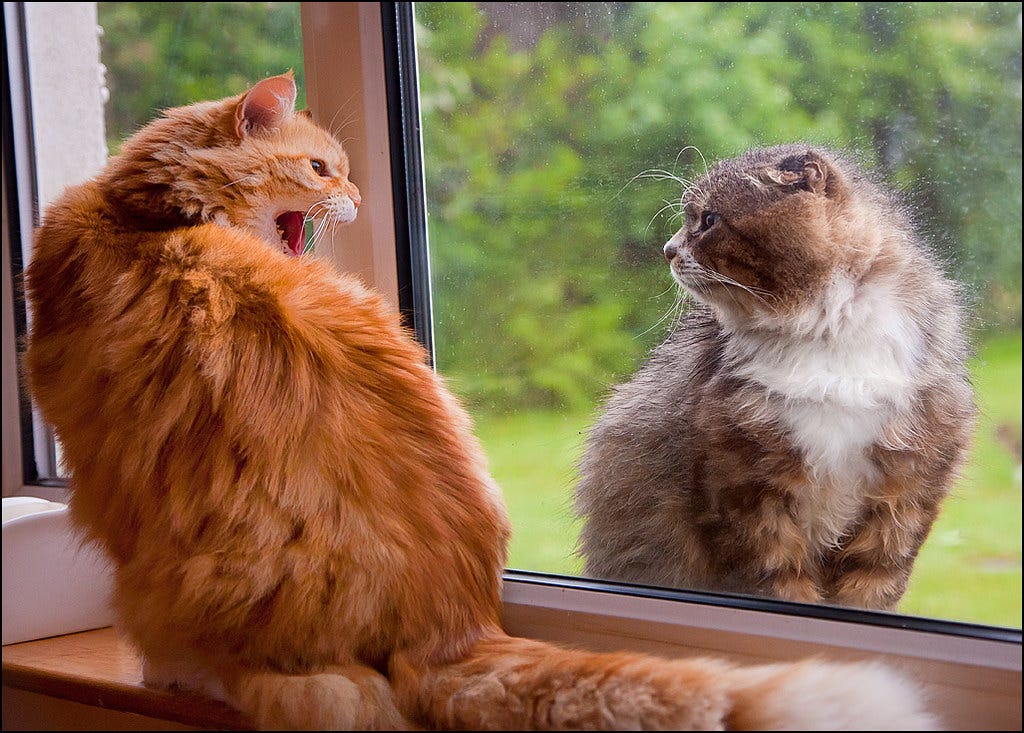
Could this story serve as a parable for approaching other enemies? Could we somehow learn to sit with the awareness that “enemy” is in fact a complex, internally inconsistent, ever-changing construct of the imagination? That reducing difficult real relationships into conflicts between cartoonish, two-dimensional opponents betrays all the constantly evolving realities of humankind?
I know from experience that the longing for clear boundaries lures us into this abstract labeling of “right” or “wrong.” But such labeling reduces every person from breathing beings into a static thing with no freedom to choose or to grow. We trick ourselves into thinking: “I don’t have to deal with you, I don’t have to get to know you, I don’t have to care about you…because you are wrong.”
The reality of dealing with my hurting friend was that change is always the ruling dynamic. One moment we could be giggling, teasing buddies. The next moment my friend could be cursing me on a long drive home while I sat at the wheel breathing deeply and telling myself, “This isn’t about me.” There were many other variations between those extremes, as many as there were moments.
Never any certainty for either of us. Only illusions of certainty, whether fed by schizophrenia or by my own ego efforts to protect myself. In my worst moments I would imagine defensive arguments that I knew my friend could not actually listen to. I wanted to “fix” my friend, to overcome the mental illness with a messy combination of reason and compassion. Not going to happen.
Even so, my friend and I got to know the depths of each other over years of caring friendship. Those vast realities within each of us did not change, despite the degeneration of our ability to remain friends in real time. In this particular case, my having crossed the empathy wall years earlier gave me two strange blessings.
First, I was able to sit non-judgmentally through wild changes of emotion and behavior, some of it very hurtful to my own feelings. I was able to wait for the mental tides to turn.
Second, when it became clear that my being a trigger for my friend had become too hurtful to both of us, I was able to let go of the friendship without blame.

I remember two other examples of friends who could have been labeled as “enemies” in terms of our irresolvable political differences. As a college freshman in 1968 I had a best friend from central Pennsylvania who as a dedicated Richard Nixon supporter. I could not abide the former colleague of Joe McCarthy and Roy Cohn.
But that had nothing to do with our friendship. We clicked as friends from the start, dwelt with each other on those terms—and left the politics alone.
As a first quarter seminarian in 1972, I found friendship with an ex-military, pro-Vietnam War roommate. We were both publicly vocal about our opposite views on that war.
Yet when students and junior faculty wanted to use the weekly Wednesday morning Eucharist service as an anti-war protest, my roommate and I joined in opposing this move. We both believed that community worship must be used for to unite the community, not to divide it.
I’m concluding this post in a rather wishy-washy way. No clarity about method. Only some examples witnessing to the possibility of embracing a complex, difficult relationship that includes “being enemies” in some realms.
As I wrote in “Groundlessness – Part 5: Crossing the empathy wall,” the exercise that sociologist Arlie Russell Hochschild calls “crossing the empathy wall” involves getting to know others nonjudgmentally, by inviting them into sharing our “deep stories.” Not the ideological stances that we learn and replicate, but the gut-level experiences that underlie our feelings about conflicting ideologies or beliefs.
Hochschild writes:
We, on both sides, wrongly imagine that empathy with the “other” side brings an end to clearheaded analysis when, in truth, it’s on the other side of that bridge that the most important analysis can begin….
But I think we need a special word, and should hold a place of honor for it, so as to restore what might be a missing key on the English-speaking world’s cultural piano. Our polarization, and the increasing reality that we simply don’t know each other, makes it too easy to settle for dislike and contempt.
When we enlarge the space in our hearts enough to long for living relationship with our “enemies,” we start to discover these deeper stories about each other. Stories that each of us is constantly rewriting as we wander through the conflicts and resolutions of our lives.
The “love your neighbor as yourself” of Leviticus 19:18 and Mark 12:31a begins with being curious about ourselves, discovering the “enemy” in ourselves. When we can accept those traits within ourselves—not get rid them, but simply acknowledge that they come into play in conflict—then we can sit with others, even in conflict, without requiring that the “enemy” in them first go away.
From Pema Chödrön (Awakening Loving Kindness):
Inquisitiveness or curiosity involves being gentle, precise, and open—actually being able to let go and open. Gentleness is a sense of goodheartedness toward ourselves. Precision is being able to see very clearly, not being afraid to see what’s really there, just as a scientist is not afraid to look into the microscope. Openness is being able to let go and to open….
Basically, making friends with yourself is making friends with all those people too, because when you come to have this kind of honesty, gentleness, and goodheartedness, combined with clarity about yourself, there’s no obstacle to feeling loving-kindness for others as well.
And so it is.
Blessèd Be.
Image source:
“Enemies,” by John Finn (6/23/2012) [CC BY-NC-ND 2.0 - Attribution-NonCommercial-NoDerivs 2.0 Generic].
Following the teachings of John Paul Ledarach and many that you also note - I have been struggling for months with reconciling the hateful rhetoric of someone I thought was decent and kind (following the election results in November). This discussion is helping me to alter my perspective and lean into letting go the harm I felt for myself, for the other marginalized, for so many that are in the pathways of this evolving regime. Alas, we are just beginning down this path as a Nation struggles to reconcile itself. We each step up in ways that align with our values. May goodness and love prevail.
People come into our lives and some of them go. We cannot blame ourselves for the differences in philosophy with these people. We must be true to ourselves and our own philosophy and beliefs. I believe that the Lord realizes this and forgives us if we cannot make a go of some relationships. Blaming ourselves for failures in these relationships keeps us from moving forward in our good relationships.
Much love,
Libbie